

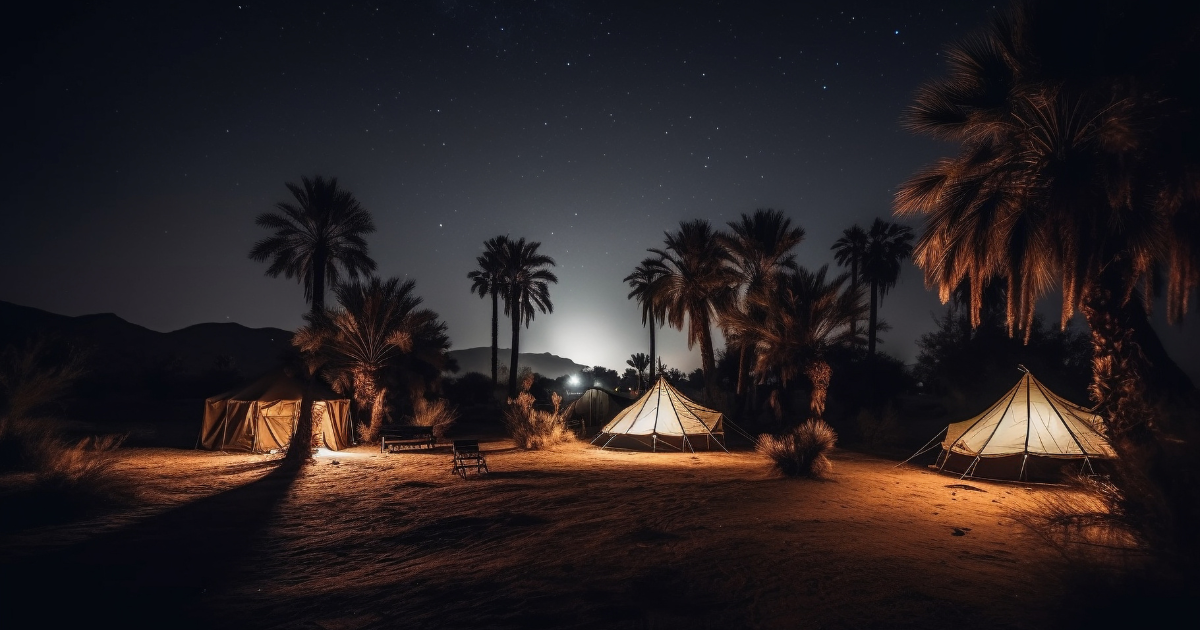
There’s a moment, just after sunset over the dunes of the Grand Erg Oriental, when the silence turns almost physical. The sand gives up the day’s heat, the wind drops, and the sky tips over into a black so deep it feels close enough to touch, pierced by more stars than most people will ever see in one place. It’s the moment every traveller remembers first when they talk about a night in the Tunisian Sahara — and it’s the reason stargazing here has quietly become one of the main draws for visitors to southern Tunisia.
Quick answer: the best stargazing in Tunisia is found deep in the Grand Erg Oriental around Ksar Ghilane and the Dahar plateau, away from Douz’s residual glow. Aim for October to March, plan around the new moon, and give your eyes at least 20 minutes to adjust before expecting to see the Milky Way in full detail.
Why the desert sky here is so exceptionally dark
Sky quality is usually measured on the Bortle scale, which runs from 1 (a truly black sky) to 9 (a saturated urban sky). Most European capitals struggle to get below class 7 or 8 on a clear night. Deep in the Grand Erg Oriental, tens of kilometres from the nearest town, it’s common to reach class 1 or 2 — a darkness that only a handful of deserts on Earth can still offer. Under those conditions, the Milky Way stops looking like a faint smudge and becomes something structural: dust lanes, star clusters, and a visible core, all without a telescope.
Two things make this possible. First, there’s simply no large city close enough to throw light pollution over the horizon. Second, the air itself is unusually cooperative. Saharan humidity is close to zero for most of the year, and atmospheric moisture is the main cause of the blur and diffusion that ruin a night sky elsewhere. Combined with almost no industrial particulate matter, this dryness produces a level of transparency that lets you pick out details invisible in most places — spiral structure in the galaxy, a handful of nebulae with the naked eye on a moonless night, and noticeably higher meteor counts during showers like the Perseids or Geminids.
When to go: season and moon phase both matter
The Tunisian desert is observable almost year-round, but not equally so. The main travel season, October to June, happens to overlap with the most comfortable nights for stargazing — the temperatures are far gentler than in high summer, when heat trapped in the sand can still sit above 30°C at midnight. From October through March, nights turn cool, dry, and ideal for long observation sessions, though the daily temperature swing can reach 20°C, so warm layers aren’t optional.
The lunar calendar deserves just as much attention as the season. A few nights around the new moon, when no lunar glow washes out the sky, consistently produce the most dramatic views. It’s worth building a trip around that narrow window — even if it means nudging a 4×4 tour or a camel trek by a day or two to make sure your night under canvas lands on a moon-free sky.
Where to actually pitch your tent
Not every corner of southern Tunisia offers the same view. Douz itself, while already far darker than any European town, still carries a faint residual glow from its streetlights. For a genuinely immersive sky, you need to go deeper — past the last dunes visible from the road, or out to the isolated oasis of Ksar Ghilane, surrounded by hundreds of kilometres of sand and rock in every direction.
The Dahar mountains are another strong option, adding a striking daytime backdrop of Berber ksour and arid valleys to the night’s main event. The slightly higher altitude of these limestone plateaus, combined with the total absence of infrastructure in some areas near Tataouine, makes the region a natural fit for travellers who want to pair cultural hiking with serious sky-watching in the same trip.
What a real night in the desert actually feels like
Stargazing here isn’t a five-minute glance before bed. It’s an experience that starts at sunset, builds around the campfire, and peaks around midnight, when the Milky Way reaches its highest point overhead. Our desert camp stays are built around exactly that arc — traditional Berber tents and proper bedding, without ever diluting the sense of being genuinely off-grid.
What our local guides call the nomadic experience is really a balancing act between authenticity and comfort. The desert sets its own rules: sharp temperature swings, sand everywhere, no electricity in the more remote spots. Getting that balance right — keeping the night a pleasure rather than an ordeal — is something we’ve refined over two decades of running these bivouacs.
The mistake most first-time visitors make
Many travellers assume the desert’s daytime heat will linger after dark. It does the opposite. Sand can’t retain heat the way clay or rock does, so it cools fast the moment the sun drops, and a lot of observation sessions get cut short by cold rather than clouds. Pack an extra fleece layer even in April, and choose a sleeping bag rated for near-freezing nights rather than a summer-weight one — the sky doesn’t wait for you to warm back up.
Five things that make the difference for a good night
A couple of decades running trips out here has taught us a few simple habits that separate an average night from a memorable one:
- Let your eyes adjust. Give it at least 20 minutes without checking a phone screen before judging what you can or can’t see — night vision takes time to reach full sensitivity.
- Camp slightly elevated. A dune ridge beats a low hollow, giving you a clear 360° horizon.
- Time it around the new moon, not just the season.
- Pair it with a daytime activity so you arrive at the bivouac tired in a good way, not exhausted.
- Bring real warm layers, not just a jacket for show.
On that last point about pairing activities: a morning hike through the dunes of the Grand Erg Oriental or an afternoon on horseback tends to work better than cramming in a full day of driving right before an observation night — you want some energy left when the sky actually gets good.
Photographing the Milky Way in the Sahara
Astrophotography out here comes with its own quirks. The total absence of artificial light — a gift for the naked eye — actually confuses a lot of automatic camera settings, which struggle to find anything to focus on. A stable tripod is non-negotiable, since wind can pick up suddenly over open dunes, and a basic grasp of manual mode is the difference between a blurry frame and a shot worth printing. Getting the exposure right without blowing out the foreground sand takes a bit of practice, but it’s one of the more rewarding skills to pick up on a desert trip.
A part of Tunisia that’s stayed genuinely quiet
Fewer than 10% of international visitors to Tunisia make it past the coast into the deep south, which is part of why the areas we work in around Douz look much the same as they did twenty years ago. That low footfall is, oddly enough, one of the best things going for stargazers: less traffic, fewer temporary lights, and a stillness at night that’s hard to find almost anywhere else on the continent.
Tunisia has made Saharan tourism a genuine development priority, with an official target to triple overnight stays in desert regions by 2030 — built around low-impact models rather than mass tourism. As one of the region’s longer-running agencies, we see that growth as a good thing only if it stays anchored in small-scale travel: opting for a small-group desert tour in Tunisia rather than a large coach itinerary is, in practice, what keeps these skies this dark for the next traveller too.
Combining a night under the stars with the rest of southern Tunisia
A stargazing night rarely stands alone in our itineraries. It usually sits inside a longer arc — starting from Djerba, crossing thermal oases, working toward the more remote dunes, and building up to a night under the Grand Erg Oriental’s sky. That mix of Roman ruins, perched Berber villages, and dramatic dunes is really what sets southern Tunisia apart from other stretches of Sahara: you get several different deserts in a single trip.
For travellers who want more than one night of it, our 7- to 14-day camel treks offer a slower, deeper immersion, with a new observation spot every evening. It’s a format inherited straight from nomadic tradition, and it’s a genuinely effective way to rebuild the kind of sensitivity to darkness that city life tends to erase.
Planning your own stargazing trip
Every desert region rewards a bit of local knowledge, and the Tunisian Sahara is no exception — cloud cover, moon phase, and even wind direction can shift where the best bivouac spot is on a given night. Our team on the ground in Douz has been adjusting bivouac locations to these conditions since 2002, and if you’d like the fuller picture before booking, our complete guide to Sahara desert tours in Tunisia walks through routes, formats, and timing in more depth.
FAQ: Stargazing in the Tunisian Sahara
Is the Tunisian Sahara actually dark enough for serious stargazing?
Yes — away from Douz, much of the Grand Erg Oriental and the Dahar plateau sit at Bortle class 1–2, among the darkest skies accessible in North Africa.
What’s the best month to see the Milky Way clearly?
Between October and March, when nights are cool and dry; pick dates close to the new moon for the strongest contrast.
Do I need special equipment?
No — the naked-eye view is already exceptional. A basic tripod and manual camera settings are worth bringing if you want to photograph it.
How cold does it actually get at night?
Expect a drop of up to 20°C from daytime highs; pack a fleece layer and a sleeping bag rated for near-freezing temperatures, even outside winter.
The Tunisian Sahara doesn’t ask much of its visitors — just a bit of patience and the willingness to get far enough from the last artificial light. In return, it offers something fewer and fewer people ever get to see: a sky genuinely black, carrying light that left its source thousands of years before it reached the dunes of the Grand Erg Oriental.