

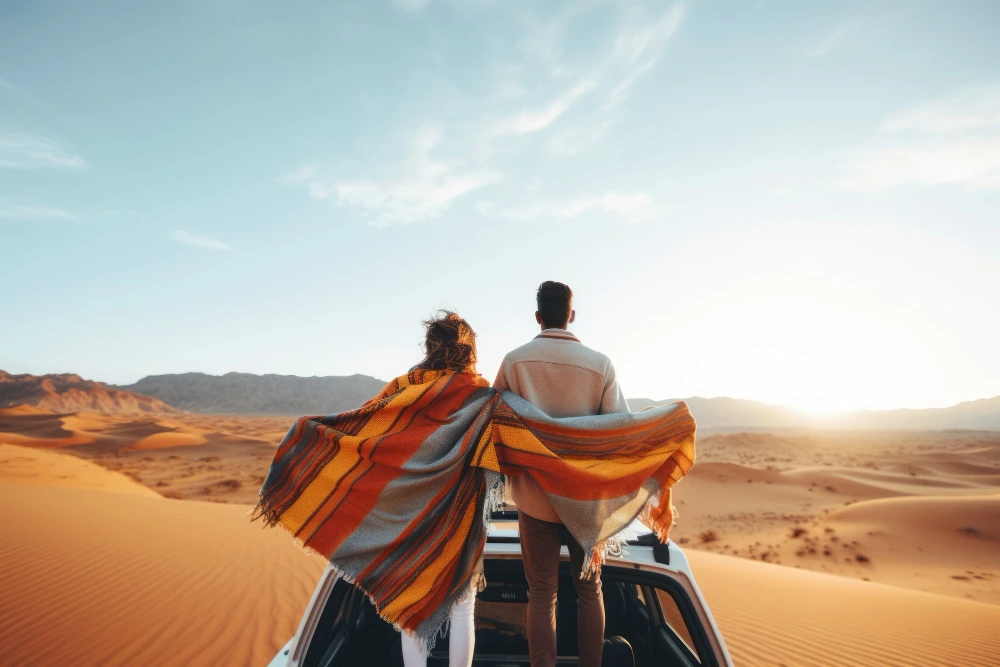
There is a moment, somewhere between the last paved road and the first golden ridge of dunes, when the Sahara stops being a postcard and becomes something you feel in your chest. The air changes. The silence deepens. The scale of it, endless sand stretching to a horizon that seems impossibly far, does something to a person that is genuinely hard to explain until you have
experienced it yourself.
A Sahara desert tour in Tunisia is one of the most accessible ways to reach that moment. Unlike other parts of the Sahara, southern Tunisia offers a remarkable combination : ancient Berber villages, Roman ruins, thermal oases, and some of the most spectacular dunes on the continent all within driving distance of the island of Djerba.
At Libre Espace Voyages, we have been guiding travellers into this landscape since 2002, and we still feel its pull every single time. This guide covers everything you need to know to plan your Tunisian Sahara adventure : the best routes, the different formats available, when to go, and what makes this desert unlike any other.
Why Tunisia for a Sahara Desert Tour ?
Tunisia sits at one of the most geographically privileged positions in North Africa. The island of Djerba, a Mediterranean beach destination by day sits just a few hours from the eastern edge of the Grand Erg Oriental, one of the largest sand seas on Earth. That proximity is extraordinary: nowhere else can you wake up to turquoise water and go to sleep surrounded by dunes the same day.
But Tunisia’s Sahara is more than just sand. The journey south unfolds like a series of revelations: the Dahar Mountains with their Berber hilltop villages, the ksour (fortified granaries) of Tataouine that inspired the architecture of Tatooine in Star Wars, the hot-spring oasis of Ksar Ghilane where Roman soldiers once rested, and eventually the deep dunes of the Grand Erg Oriental where the desert truly takes over. Each landscape is distinct, and together they make a Sahara desert tour in Tunisia a cultural and natural journey, not just a dune experience.
The infrastructure for travellers is also well developed without being overcrowded. Private 4×4 expeditions are still possible even in peak season, and genuine nomadic camps not staged tourist villages are accessible with the right local guide.
The Best Desert Routes from Djerba
The classic one-day desert excursion
For travellers with limited time, the one-day route from Djerba to Ksar Ghilane is the benchmark. You head south through the Roman causeway that connects the island to the mainland, pass through the mountain villages of the Dahar, and arrive at the oasis with enough time for a swim in the natural thermal spring, a lunch among the palms, and a late-afternoon walk into the dunes before returning to Djerba. It is a long day typically 10 to 11 hours, but every hour of it counts. The landscape changes so dramatically so quickly that the journey itself is part of the experience.
The two-day Sahara expedition
This is the format we most consistently recommend to our clients, and it has become our most-requested program. Spending a night in the desert changes everything. You get to see the desert at sunset, when the dunes turn amber and the shadows grow long and theatrical. You get to experience the silence after dark, when the temperature drops and the sky fills with more stars than most people have ever seen. And you get an unhurried morning in the desert before the heat builds, the most beautiful light of the entire trip.
The 2-day Sahara expedition from Djerba typically combines Berber village visits, the Ksar Ghilane oasis, and a night in the deep dunes south of the oasis often at our own Zmela camp, which we cover in detail below.
Multi-day circuits: one week in the Tunisian desert
For those who want to go deeper literally and figuratively our week-long desert circuits take you through the full range of southern Tunisia’s landscapes: Matmata’s troglodyte houses, the ksour circuit around Tataouine and Chenini, the palm groves of Tozeur, the salt flats of Chott el Djerid, and the high dunes of the Grand Erg. These are the tours where the desert becomes a world rather than a backdrop.
Browse all our available desert tours and excursions from Djerba to see the full range of itineraries and durations.
Camel Trekking : The Most Immersive Way to Cross the Sahara
There is a fundamental difference between driving through the Sahara and walking through it alongside a camel. In a 4×4, the desert passes by. On a camel, you enter it, at the desert’s own pace, through the desert’s own logic, with the same rhythmic sway that Tuareg and Berber nomads have used for centuries to cross this landscape.
Camel trekking in Tunisia is one of the most distinctive experiences we offer, and it is designed for travellers who want genuine immersion rather than a quick photo opportunity. Also, our trekking programs range from 7 to 14 days, following ancient caravan routes through the Grand Erg Oriental and the Dahar Mountains.
What camel trekking in the Tunisian Sahara actually involves
A typical day on the trek begins before sunrise, when the desert is cool and the light is extraordinary. You ride or walk alongside the camels for four to five hours, stopping at pre-selected spots for tea, rest, and meals prepared by your guide over a campfire. Afternoons are spent at the camp reading, exploring nearby dunes, watching the light change as the sun descends.
The guides on our camel treks are almost exclusively Berber locals who grew up in this landscape. Their knowledge of the desert navigation by dune shape and star position, medicinal plants, the precise location of water sources is not something that can be learned from a textbook. Travelling with them is itself an education.
Camel trekking for beginners
No prior experience is necessary. The dromedaries used in the Tunisian Sahara are accustomed to carrying travellers, and the pace of the trek is designed to be accessible even to those who have never ridden before. Besides, most of our clients do a mix of riding and walking throughout the day whatever feels comfortable.
The one thing to prepare for is the physical reality of camel riding: it uses muscles that most people have not used before, and the first day or two involve a period of adjustment. By day three, most trekkers find it deeply natural and deeply peaceful.
Overnight Desert Camps : Sleeping Under the Stars in Tunisia
If there is one element of a Sahara desert tours in Tunisia that travellers consistently describe as life-changing, it is the night. The Tunisian Sahara, far from any city light pollution, offers a view of the night sky that is increasingly rare in the modern world. The Milky Way is not a faint smear, it is a full arc overhead, dense and luminous, with shooting stars every few minutes on a clear night.
An overnight desert camp in Tunisia bridges the gap between comfort and authenticity. You are genuinely in the desert no hotel, no road, no light except the stars and a campfire but with the essentials provided: a proper sleeping structure, warm blankets, and food prepared by a desert cook who takes the job seriously.
Zmela Camp: our base in the heart of the dunes
A few kilometres south of Ksar Ghilane, deeper into the Grand Erg Oriental than most travellers ever reach, Zmela Camp is our permanent desert base. It sits directly among the dunes, with no road between the camp and the horizon.
The camp offers proper tents with beds rather than sleeping bags on sand, a covered restaurant area protected from the desert wind, and working bathrooms with hot water a detail that matters more than people expect after a long day in the Sahara. The kitchen produces traditional Berber and Tunisian food: slow-cooked tagines, fresh bread baked in the sand, mint tea brewed over charcoal.
From Zmela, the dunes are immediately accessible. You can walk out alone in the late afternoon and climb a ridge in ten minutes from the top, nothing man-made is visible in any direction. The camp itself disappears behind the first dune you climb.
What an overnight desert camp stay looks like
Guests typically arrive in the late afternoon, in time to drop bags and walk into the dunes for sunset. Dinner is served around a fire after dark, with the temperature already dropping noticeably from the afternoon heat.
The night is long and quiet; the only sounds are occasional wind and, in season, the distant percussion of sand shifting between dunes. Breakfast is early, before the heat builds, and the morning light on the dunes is by almost universal agreement among our clients the single most beautiful moment of the entire trip.
The overnight desert camp experience is available as part of our 2-day Sahara expedition, or as a standalone stay for travellers who arrive with their own vehicle and want a base in the deep desert.
How to Choose Your Sahara Tour: A Practical Guide
By time available
| Available time | Best format |
| Half a day | Dunes activity from Djerba (short excursion) |
| 1 full day | Ksar Ghilane oasis day trip |
| 2 days | 2-day Sahara expedition with overnight camp |
| 1 week | Full south Tunisia desert circuit |
| 7–14 days | Camel trekking program |
By travel style
- Adventure-focused travellers tend to gravitate toward the 4×4 raids and camel treks long days, varied terrain, full immersion in the desert environment.
- Culture-focused travellers often find the most value in the circuits that combine Berber villages, Roman sites, and the ksour the desert is the backdrop, but the human history is the story.
- Families with children do well with the one or two-day excursions, where the pace is structured and the highlights are concentrated. Ksar Ghilane’s thermal spring is consistently popular with younger travellers.
- Couples and small groups looking for something genuinely memorable tend to choose the overnight camp experience, it is the format most often cited in reviews as a trip highlight.
Private vs group departures
All our programs are available as private departures, meaning your group travels alone with a dedicated guide and driver. This allows us to adapt the pace, route, and activities to your specific interests. Group departures are available for our one-day excursions and allow solo travellers and pairs to share the experience with others.
Best Time to Visit the Tunisian Desert
Spring (March–May): the ideal season
Spring is the most popular time for a Sahara desert tour in Tunisia, and for good reason. Daytime temperatures range from 20°C to 28°C warm enough to enjoy the desert without suffering in it. The dunes hold colour beautifully in the soft spring light, and the nights are cool enough to sleep comfortably without heavy equipment.
March and April in particular offer the best combination of weather and manageable crowds.
Autumn (September–November): the second season
Autumn mirrors spring in quality and is slightly less crowded. October and November are excellent months for camel trekking in particular, the days are long enough to cover real ground without the summer heat.
Summer (June–August): possible but demanding
Summer is doable with the right preparation and adjusted scheduling (early departures, long midday rest), but daytime temperatures in the Grand Erg Oriental regularly reach 40°C or above. We recommend summer only for experienced desert travellers who specifically want the full heat experience.
Winter (December–February): cold but spectacular
Winter in the Tunisian desert is genuinely cold at night, temperatures can drop below freezing but the days are clear, the light is extraordinary, and the desert is at its least crowded. A winter overnight camp in Tunisia, wrapped in Berber blankets around a fire with a sky full of stars overhead, is an experience that many of our clients describe as the most memorable of their lives.
Book Your Sahara Desert Tour in Tunisia
Libre Espace Voyages is a locally-based Tunisian travel agency with over 20 years of experience organising desert tours and expeditions in southern Tunisia. We are not a platform that aggregates third-party guides; every tailor-made desert tour we run is led by our own team of local Berber guides and drivers who know this landscape intimately.